How Much Does a Website Cost in Australia? 2026 Pricing Guide
Website quotes in Australia can range from a few hundred dollars to six figures for what sounds like the same thing. Here's what actually drives the price, what each budget level gets you, and the ongoing costs most quotes leave out.
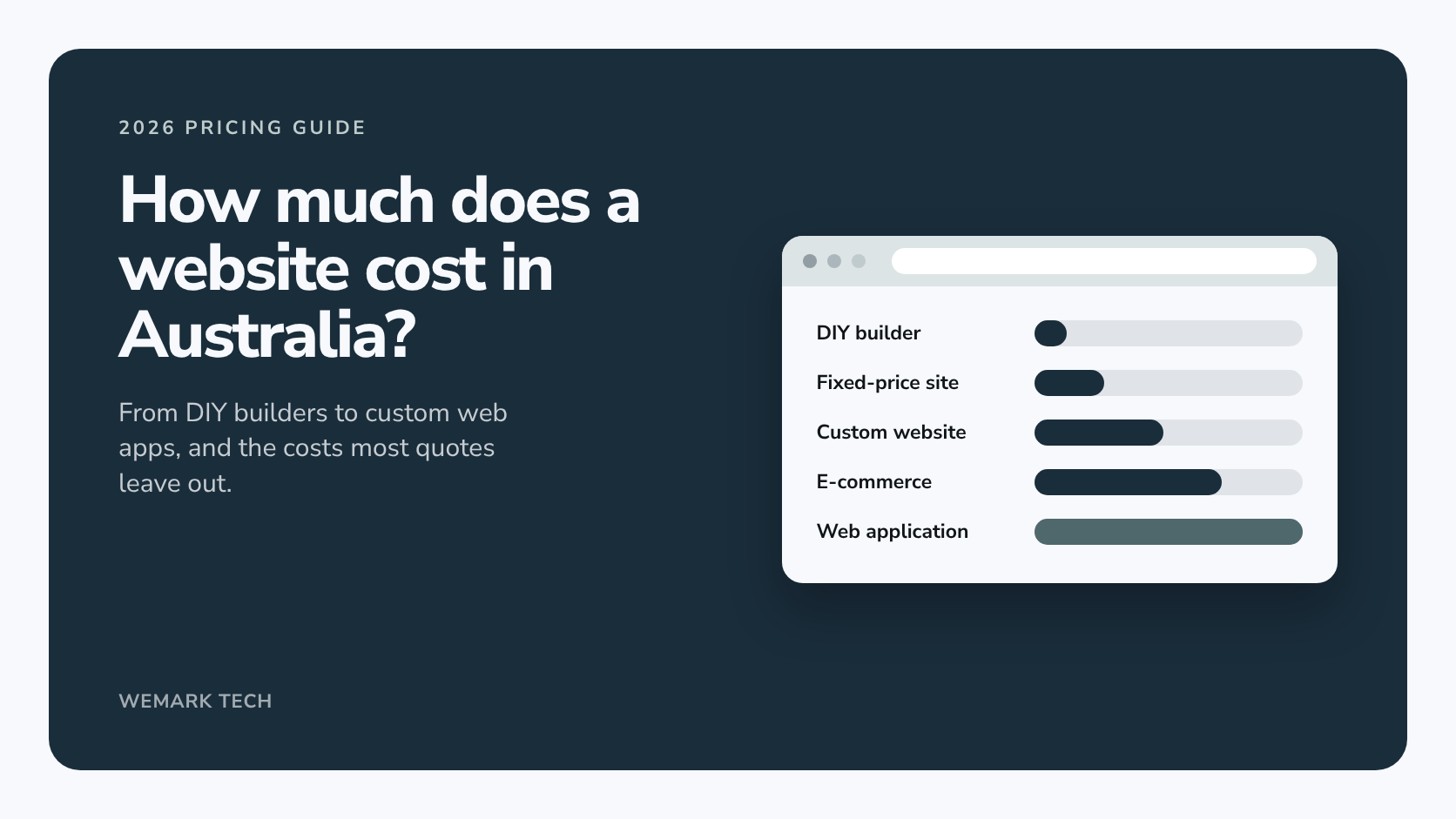
Short answer: in Australia in 2026, a website can cost anything from a monthly DIY builder subscription to well over $100,000 for a custom web application. For a typical small business, a professionally built website usually sits somewhere between about $1,500 and $15,000, depending on how many pages you need, how custom the design is, and what the site has to do beyond showing information.
That's a wide range, so the rest of this guide breaks it down: what each budget level actually buys, what pushes a quote up, and the ongoing costs that often aren't in the first number you see.
What the market is charging right now
When we searched Google for small business website design in October 2026, advertised starting prices on the first page ranged from $599 for a fixed-price small business site, to $1,500 for a custom WordPress build, to A$4,500 for an agency website. One Australian agency comparison guide put the full market range at $3,000 to $250,000+.
Starting prices are exactly that. They tell you the cheapest version of the product, not what your project will cost. The useful question is which tier you belong in.
Website costs in Australia by type
These are indicative ranges based on advertised Australian pricing. Your quote will depend on scope, but this is a sensible way to sanity-check what you're being offered.
| Type of website | Typical cost | Best suited to |
|---|---|---|
| DIY website builder (Wix, Squarespace and similar) | Monthly subscription, plus your time | Very early-stage businesses with simple needs and time to build it themselves |
| Template or fixed-price small business site | About $600 to $3,000 | Sole traders and small service businesses that need a credible presence quickly |
| Custom-designed business website | About $3,000 to $15,000 | Established businesses competing on brand, trust and search visibility |
| E-commerce website | About $5,000 to $30,000+ | Businesses selling products online, priced by catalogue size, payments and integrations |
| Custom web application or portal | About $20,000 to $250,000+ | Booking systems, client portals, marketplaces and software products |
What actually drives the price of a website
Two quotes for "a five-page website" can differ by thousands of dollars because they're quoting different things. These are the factors that move the number most.
1. Custom design vs a template
A template is a design someone else made that gets filled with your content. A custom design is built around your brand, your customers and the actions you want them to take. Custom costs more, but it's also how you stop looking like every other business using the same theme.
2. Number of unique page layouts
Price is driven less by the number of pages than by the number of different pages. Ten service pages that share one layout cost far less to build than five pages that each need their own structure.
3. Functionality
A contact form is simple. Online bookings, quote calculators, member logins, payment processing and integrations with your CRM or calendar each add design, development and testing time. This is usually the biggest single driver of cost.
4. Content
Someone has to write the words and supply the images. If the quote includes professional copywriting or photography, it will be higher, and usually worth it. If it doesn't, budget the time to write your own content, because it's often what delays a launch.
5. Rebuilding an existing site
Replacing a site that already gets traffic means mapping every old URL to its new home with redirects, so you don't lose the rankings you've earned. It's careful work, and a quote that skips it can cost you far more in lost enquiries than it saves.
6. SEO and performance foundations
Page titles, descriptions, a sitemap, structured data, fast load times on a phone and clean URLs should be part of the build, not an add-on. Check whether they're included. Ongoing SEO to compete for competitive searches is a separate service.
The ongoing costs most quotes leave out
The build is a one-off. A website also has running costs, and you should know what they are before you sign.
- Domain name. A .com.au domain is usually a modest yearly fee, and you need an Australian presence such as an ABN to register one. Make sure it's registered in your business's name, not your developer's.
- Hosting. Anything from a few dollars a month for a simple site to considerably more for a busy store or web application.
- Maintenance and updates. Security updates, plugin updates (if your site uses them), backups and small content changes.
- Software subscriptions. Booking tools, e-commerce platforms, email marketing and premium plugins often charge monthly.
- Marketing. A website doesn't bring visitors on its own. SEO, advertising and social media are what put it in front of customers.
Watch for "free" websites on long contracts. Some providers offer a low upfront price in exchange for a monthly fee locked in for 12 to 48 months, and you may not own the site at the end. Always ask who owns the domain, the design and the content, and what happens if you leave.
DIY website builder or a web developer?
A DIY builder is a reasonable choice when your needs are simple, your budget is tight and you have the time to build and maintain the site yourself. It's harder to justify when:
- your website is how most customers find and judge you
- you need specific functionality, such as bookings, quotes, a portal or integrations
- you're competing for search visibility in a crowded local market
- your time is worth more running the business than learning a page builder
A good developer will tell you honestly if a DIY builder is enough for where you are right now.
Questions to ask before you pay for a website
- What exactly is included, and what would cost extra?
- Who owns the domain, the website files and the content when it's finished?
- Is on-page SEO (titles, descriptions, sitemap, structured data) included?
- If you're replacing my existing site, how will you handle redirects?
- How fast will the site load on a phone, and how will you test it?
- What are the ongoing costs for hosting, maintenance and software?
- Can I update content myself, and do I need to?
- What support is included after launch, and what does it cost after that?
- Can I see websites you've built and talk to the businesses behind them?
What a website costs with Wemark Technologies
We keep pricing simple. Our Brand + Website package is $1,500 AUD and includes a logo, brand book and a custom, mobile-first multi-page website with on-page SEO, a sitemap and structured data, contact form and analytics, domain and hosting setup, and 30 days of post-launch support.
E-commerce, web applications and larger builds are quoted after a short scoping call, so you see the price before any work starts. We design and build everything in-house in Adelaide, the same way we built our own software platforms, LeadGlue and Offer Glue. You can see the details on our website development page, and examples on our work page.
Frequently asked questions
How much does a small business website cost in Australia?
Most small business websites built by a professional cost between about $1,500 and $15,000. Fixed-price packages for simple sites start lower, while custom design, more page layouts and extra functionality push the price up.
Is $1,500 enough for a good website?
For a standard business website with a handful of pages, a contact form and solid SEO foundations, yes, provided the scope is clear. It won't cover a complex online store or a custom web application, which are quoted separately.
How much does website maintenance cost?
It depends on how the site is built and what it does. A simple, well-built static site needs very little, while a site with many plugins, an online store or custom functionality needs regular updates and monitoring. Ask for ongoing costs in writing before you commit.
How long does it take to build a website?
A straightforward business website can be built in a few weeks once content is ready, while e-commerce sites and web applications take longer. Delays most often come from content and feedback, so agree a timeline and who supplies what at the start.
Should I pay for a website upfront or monthly?
Paying upfront usually costs less over time and means you own the result. Monthly plans can help cash flow, but read the contract length, the total cost and what you own at the end before signing.
The bottom line
The right price for a website is the one that matches what it needs to do. A clear scope, written inclusions and honest advice on ongoing costs matter more than the headline number. If you'd like a straight answer on what your website should cost, talk to our team.