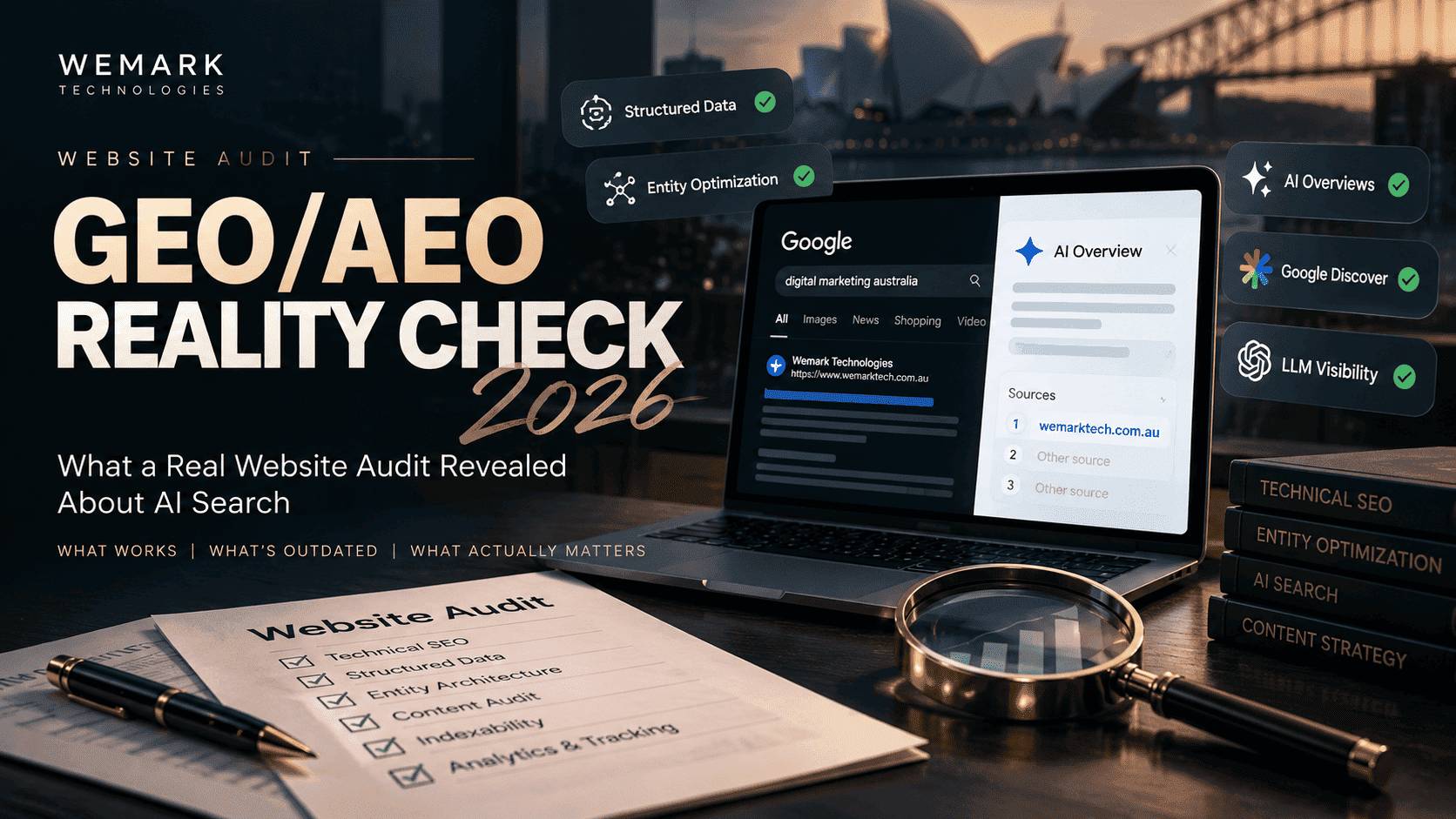
The 2026 GEO/AEO Reality Check: What a Real Website Audit Revealed About AI Search
We audited a live business website for GEO and AEO in 2026. The audit revealed a simple truth: AI-search visibility is less about finding a secret schema trick and more about making a website technically accessible, clearly structured, genuinely useful, and easy for search systems to understand.
Quick Answer
GEO and AEO are not a replacement for SEO. Google's current guidance says foundational SEO practices continue to apply to its generative AI search experiences. The practical priorities are crawlability, indexability, useful and original content, clear site structure, good page experience and accurate information. Google also says there is no special markup or secret file required to appear in its AI search features.
In 2026, FAQPage structured data should not be treated as a major Google AI-search optimisation tactic. Google discontinued the FAQ rich result from Search starting May 7, 2026. FAQ content can still be useful to readers, but the former FAQ rich-result treatment is gone.
Why We Did This Audit
The search landscape in 2026 looks very different from the traditional ten-blue-links model. Google has generative AI experiences, users increasingly ask conversational questions, and businesses want to understand whether their content can be surfaced or referenced by AI-powered search.
That has created a new market for GEO and AEO advice. Some of it is useful. Some of it is simply traditional SEO with a new label. And some of it is built around tactics that sound technical but are not supported by current search documentation.
Instead of starting with theoretical GEO hacks, we started with a real website and audited the fundamentals.
1. GEO/AEO Still Starts With SEO
Google's own guide to generative AI search says SEO remains relevant because its generative AI features are grounded in core Search systems. Pages need to be crawlable, indexable and eligible to appear in Search before they can be considered for Google's generative AI experiences.
A serious GEO audit therefore starts with ordinary technical questions:
- Can search engines crawl the important pages?
- Can the pages be indexed?
- Are canonical URLs clear?
- Is the site's architecture understandable?
- Does the content genuinely answer the user's need?
- Can the business and its content be clearly understood?
If the technical foundation is broken, adding another layer of AI-focused markup does not fix the underlying problem.
2. The FAQ Schema Myth Needed a Reality Check
One of the clearest examples of outdated SEO advice is the continued presentation of FAQPage structured data as a major Search optimisation tactic.
Google announced that the FAQ rich-result feature would no longer appear in Google Search starting May 7, 2026. Google subsequently marked the FAQ rich-result documentation as deprecated.
This distinction matters because FAQ content and FAQPage structured data are not the same thing.
Still useful: a well-written FAQ section when customers genuinely have recurring questions.
Outdated assumption: adding FAQPage markup everywhere will unlock Google AI Overviews, Discover visibility or LLM citations.
Google does not document FAQPage structured data as a requirement for appearing in AI Overviews or AI Mode. In a 2026 audit, FAQ markup should therefore be judged by its documented purpose, not by an assumed AI-ranking shortcut.
3. Structured Data Still Has a Job Just Not a Magic Button
Structured data remains useful because it gives search engines explicit information about what a page represents. Google says Article structured data can help it better understand article titles, images, dates and authors.
The audit therefore focused on accurate structured data, not maximum structured data.
For an article, that means identifying the content as a blog article and providing the correct headline, image, publication date, author, publisher and canonical page. Google's structured-data guidelines also make clear that correct markup does not guarantee a particular rich result.
4. Entity Consistency Is More Useful Than Schema Quantity
A modern business website contains many signals about the same organisation: the homepage, About page, contact information, social profiles, services, articles and authors.
A better audit question is not “How many schema types can we add?” but:
Can a search system consistently connect the business, its website, its content and its authorship?
A stable organisation identity can help keep those relationships consistent. Article publisher information can then point back to the organisation instead of creating a different anonymous organisation object on every page.
5. Canonicals Are Still a GEO Foundation
AI search does not eliminate the need to establish the preferred URL for a piece of content. During a technical audit, canonical URLs should be checked across important pages, especially where URL variants, parameters, redirects or duplicated paths exist.
Before worrying about whether an AI system can cite a page, make sure the search engine can confidently identify the page itself.
6. Sitemap and Robots.txt Still Matter
A sitemap is not an AI-ranking trick. Robots.txt is not an AI-ranking trick either. But both belong in a serious technical audit because search systems need to discover and access the content they are expected to understand.
The audit included sitemap validation, Search Console checks, URL inspection and review of crawler access. These are ordinary technical SEO activities and that is precisely the point.
7. Content Architecture Beats Random AI-Generated Articles
GEO has created another tempting shortcut: publish large quantities of AI-generated articles containing questions, definitions and keyword variations.
Quantity alone does not create a strong information source. A better content architecture connects:
- a clear topic
- a specific user question or search intent
- a direct answer
- supporting evidence
- clear authorship
- relevant internal links
- related content
- the business or organisation behind the information
Google's current generative AI guidance emphasises helpful, reliable, people-first and non-commodity content. That makes content quality and originality more important than simply increasing page count.
8. Author and Publisher Information Should Be Clear
A blog article has an author, a publisher, a publication date and a specific URL. Google's Article structured-data documentation recommends providing author information and other article properties that help Google understand the page.
Author → Article → Publisher → Website
That does not guarantee AI citations. It creates a clearer representation of the content and the organisation behind it.
9. Google Discover Is Not an FAQ Schema Strategy
Google Discover is a different search experience from a traditional keyword query. It should not be treated as an extension of FAQ rich results.
Discover strategy should instead consider relevant content, strong visual assets, page experience and the site's broader search presence. Google is also expanding reporting around newer visual and multimodal search experiences.
In September 2026, Google announced new Search Console reporting for web multimodal search, including experiences such as Lens, Circle to Search, image uploads and “Search this image”.
10. Measurement Is the Missing Layer in Many GEO Strategies
A website cannot be meaningfully optimised if nobody knows what happens after publication.
- Search impressions and clicks
- Organic landing pages
- Indexing and crawl issues
- Search queries and content performance
- Generative AI search visibility where reporting is available
- Conversions and meaningful business outcomes
The goal is not to collect dashboards for their own sake. It is to connect search visibility to actual business performance.
11. The GTM/GA4 Lesson: Audit Before You Delete
The audit also exposed a practical problem: tracking ownership. The website already had a Google Tag Manager container implemented, but the current team did not yet have access to the existing container.
Never delete an unknown tracking container before understanding what is inside it.
An existing GTM container can contain analytics tags, Google Ads conversions, remarketing, custom events, triggers or third-party integrations. Replacing it without an audit can create tracking gaps.
- Confirm ownership and access.
- Audit the existing container.
- Identify active tags, triggers and conversions.
- Decide whether to retain or replace the setup.
- Configure GA4 and required measurement.
- Test events and conversions.
- Deploy only after validation.
What Actually Matters in a 2026 GEO/AEO Audit?
| Audit area | 2026 focus |
|---|---|
| Technical SEO | Crawlability, indexability, canonical URLs, performance and clean architecture |
| Content | Useful, original, evidence-supported and people-first information |
| Structured data | Accurate markup that reflects the actual page content |
| Entity clarity | Consistent organisation, author and publisher relationships |
| AI search | Strong SEO foundations rather than unsupported “GEO hacks” |
| FAQ content | Useful for readers when appropriate; former FAQ rich-result expectations are outdated |
| Discover & visual search | Relevant content, strong imagery and attention to evolving Search experiences |
| Measurement | Search Console, analytics, conversions and available generative-AI reporting |
The 2026 GEO/AEO Reality Check
After going through a real website audit, the biggest lesson was not a particular schema type.
It was information architecture.
Search systems need to understand who the organisation is, what the website is about, which URL represents each piece of content, who created the content, what it says, where important claims come from, whether it can be crawled and indexed, and how the pages relate to one another.
That is not a secret AI hack. It is a well-structured website.
GEO and AEO can be useful terms for describing work around AI-search visibility, but the practical foundation is still search optimisation: technically accessible pages, useful content, clear entities, accurate structured data, strong information architecture and measurable outcomes.
What We Would Check First in Any 2026 GEO/AEO Audit
- Crawlability: Can search engines access important content?
- Indexability: Are important pages eligible to appear in Search?
- Canonicalisation: Is the preferred URL clear?
- Sitemap: Are important URLs discoverable and current?
- Content quality: Does the site provide something genuinely useful?
- Entity clarity: Is the organisation consistently represented?
- Structured data: Does the markup accurately match the visible page?
- Authorship: Is the content's author and publisher clear?
- Internal architecture: Are related topics connected logically?
- Measurement: Can visibility and business outcomes actually be tracked?
Frequently Asked Questions
Is FAQPage schema still important in 2026?
FAQ content can still be useful when it answers genuine customer questions, but Google discontinued the FAQ rich result from Search starting May 7, 2026. FAQPage markup should therefore not be presented as a major Google AI-search visibility requirement.
Does GEO replace SEO?
No. Google's current guidance says foundational SEO practices remain relevant to its generative AI search experiences. GEO and AEO are industry terms for work focused on AI-search visibility, not replacements for technical SEO or useful content.
Does structured data guarantee AI Overview visibility?
No. Structured data can help search engines understand page content, but Google does not guarantee a particular search appearance even when markup is correctly implemented.
Should every website add special AI files such as llms.txt?
Google's current generative AI Search guidance says websites do not need special AI markup or files such as llms.txt to appear in Google Search or its generative AI features.
What is the most important part of a GEO/AEO audit?
There is no single schema tag that guarantees visibility. A useful audit starts with crawlability and indexability, then examines technical structure, content quality, entity clarity, structured data, internal linking, authorship and measurement.
Sources & Further Reading
- Google Search Central: Optimizing your website for generative AI features on Google Search
- Google Search Central: Latest documentation updates
- Google Search Central: Article structured data
- Google Search Central: Structured data supported by Google Search
- Google Search Central: Web multimodal Search performance reporting in Search Console
Where to Start
If your website has been optimised using an old SEO checklist, don't start by adding more schema. Start by auditing what is already there.
- Check crawlability and indexability.
- Validate canonical URLs.
- Review sitemap and robots.txt.
- Audit structured data for accuracy and relevance.
- Map organisation, author and publisher entities.
- Review content quality and internal linking.
- Check Search Console and analytics.
- Remove or rethink tactics that are no longer supported by current search guidance.
The future of search is changing quickly. The websites prepared for it will not necessarily be the ones with the most markup. They will be the ones that make their information easiest to crawl, understand, verify and use.
Is your website ready for AI search?
Wemark Technologies can audit your technical SEO, content architecture and AI-search foundations to identify what is working, what is outdated, and what should be fixed first.
Book a consultation