How Much Does SEO Cost in Australia? A 2026 Pricing Guide
Most Australian businesses pay about $1,000 to $5,000 a month for ongoing SEO. Here's what drives the price, what each budget should buy and how to tell whether it's worth it.
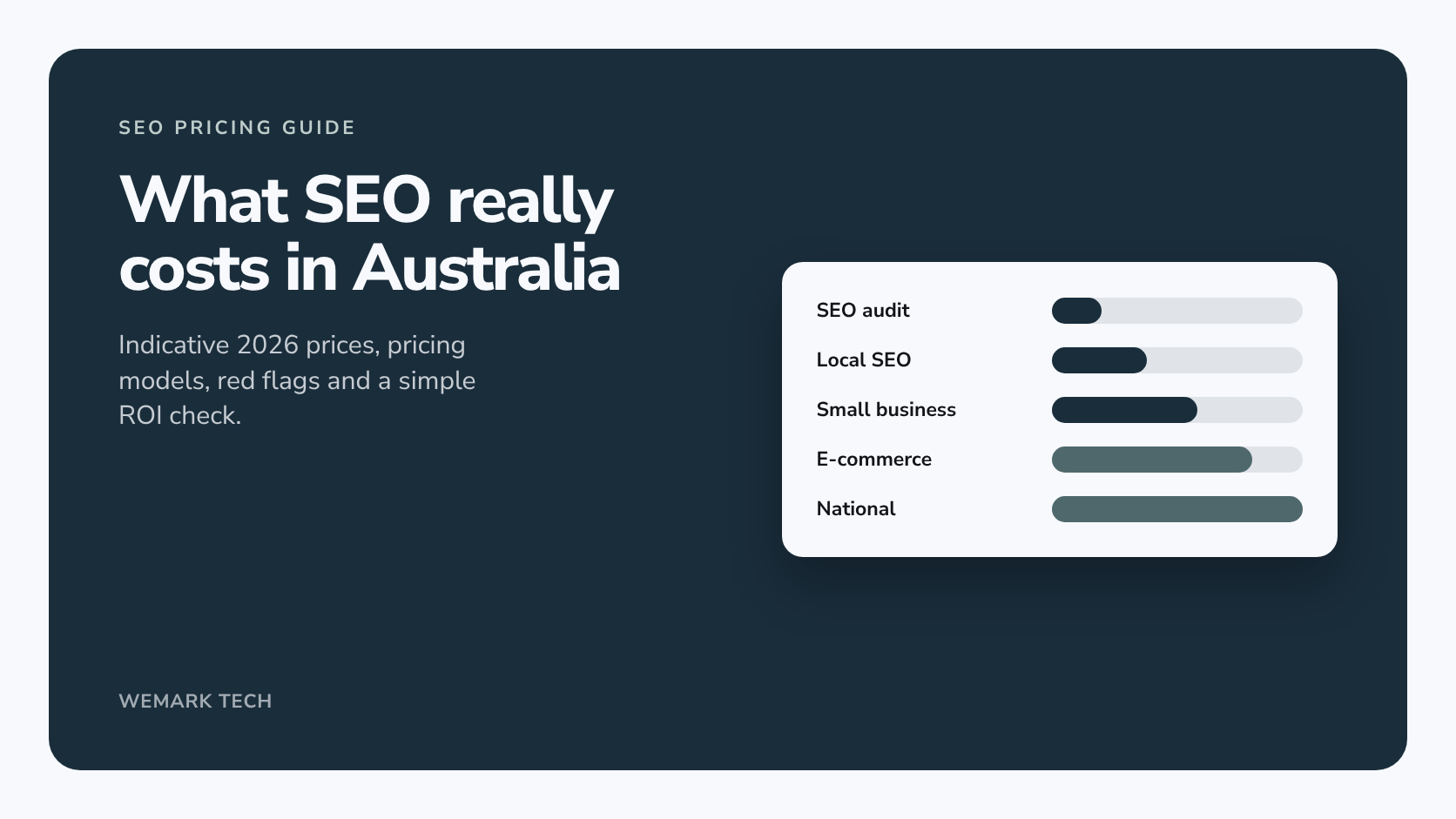
Short answer: most small and mid-sized Australian businesses pay somewhere between about $1,000 and $5,000 a month for ongoing SEO. Entry-level local packages are advertised from around $500 a month, competitive national and e-commerce campaigns often run to $5,000 a month or more, and a one-off SEO audit typically costs about $1,500 to $10,000 depending on the size of the site.
This guide explains the pricing models you'll come across, what each budget should buy, the red flags to avoid, and a simple way to work out whether SEO is worth it for your business.
SEO cost in Australia by business type
These indicative ranges are based on the pricing guides Australian agencies published on the first page of Google in October 2026. Those guides don't agree on every number, and they're written by businesses that sell SEO, so treat the table as a sanity check rather than a price list. Many prices are also quoted excluding GST.
| Type of SEO work | Indicative cost (AUD) | What it usually covers |
|---|---|---|
| Local SEO for a small business (one location, one city) | About $500 to $2,500 a month | Google Business Profile, reviews, location and service pages, technical fixes and a modest amount of content |
| Competitive metro or national SEO | About $3,000 to $10,000+ a month | A larger keyword set, regular content, digital PR and link earning, and deeper technical work |
| E-commerce SEO | About $1,800 to $5,000+ a month | Category and product pages, site structure and technical SEO across the catalogue; large stores sit higher |
| One-off SEO audit | About $1,500 to $10,000+ | A prioritised list of technical, content and local issues, priced by site size and depth |
| Site migration or rebuild support | About $3,000 to $10,000+ | Redirect mapping and checks before and after launch to protect existing rankings |
| Hourly consulting | About $150 to $300 an hour | Strategy sessions, team training, second opinions and specific problems |
SEO pricing models explained
Monthly retainer
The most common model: a fixed monthly fee for an agreed scope of ongoing work, such as technical fixes, content, local visibility, link earning and reporting. It suits SEO because results build over months. Check the minimum term, notice period and monthly deliverables.
One-off audit or project
A fixed price for a defined piece of work, such as a technical audit, a content plan or protecting your rankings during a website rebuild. It suits businesses with someone who can act on the recommendations, because an audit on its own changes nothing.
Hourly consulting
Useful for strategy, training or a second opinion on a proposal. Agree a monthly cap so costs stay predictable.
Performance-based SEO, and its catches
Some providers tie fees to rankings, traffic or revenue. It sounds low-risk, but read the detail.
- The target decides the bill. Paying per ranking for obscure keywords can mean paying for positions no customer ever searches.
- Attribution is messy. If fees depend on traffic or revenue, agree in writing how they're measured and who controls the analytics.
- Incentives can push risky tactics. A provider paid only for fast movement may take shortcuts that put your site at risk later.
- Read the fee formula. Ask whether there's a base fee, what you pay if targets are missed, and what happens to the work if you leave.
What drives the price of SEO?
Two quotes for "SEO for my business" can differ by thousands of dollars a month. These are the main reasons.
- Competition. Ranking a family law firm in Sydney takes far more work than ranking a mobile dog groomer in a regional town.
- Geographic reach. One suburb, one city, several states or the whole country. Each step widens the keyword set and the competition.
- Your starting point. A slow site with indexing problems needs repairs first, and a brand-new domain has no authority yet.
- Site size. A ten-page service site and a store with thousands of products need very different technical and content effort.
- Content volume. If competitors have a useful page for every service and question, you'll need comparable coverage.
- Who does the work. Senior strategists cost more than juniors or offshore teams, and if your provider can't edit your site, every fix waits on a developer.
What should you get at each SEO budget?
A useful way to read a monthly fee is to convert it into hours. At agency rates of roughly $150 to $250 an hour, $1,500 a month buys around 6 to 10 hours of work. That's real work, but not a lot of it, which is why scope matters more than the headline price.
Under about $1,000 a month
Expect the basics for a single-location business in a low-competition market: Google Business Profile work, obvious technical fixes, a handful of optimised pages and simple reporting. There's little room for new content or link earning.
About $1,000 to $3,000 a month
This is where most small businesses sit. You should see a documented strategy, steady technical improvements, new or improved pages each month, local visibility work, some link and mention earning, and a monthly report tied to enquiries rather than rankings alone.
$3,000 a month and up
Suited to competitive metro or national markets and larger online stores. Expect more content, outreach or digital PR to earn links, deeper technical work and regular strategy sessions with a senior person.
SEO red flags to watch for
- Guaranteed rankings. Google's own guidance on hiring an SEO says no one can guarantee a #1 ranking on Google, and that a provider who promises one is a reason to look elsewhere.
- Very cheap packages. A couple of hundred dollars a month can't buy much skilled work at Australian rates. It often means automated reports, bulk low-quality links or very little at all.
- No reporting, or reports you can't follow. You should get a clear monthly summary of what was done, what changed and what's next, plus your own access to Google Search Console and Google Analytics.
- Link schemes. Offers of hundreds of backlinks, private blog networks or paid guest posts. Google's spam policies treat buying or selling links for ranking purposes as link spam, and Google warns this can lead to a manual action that hurts your rankings.
- Secrecy and lock-ins. A provider who won't explain their work, keeps your accounts in their name, or locks you into a long contract.
Local SEO vs national SEO: how the costs differ
Local SEO targets customers in a defined area, usually searching for a service "near me" or in a named suburb. The work centres on your Google Business Profile, reviews, consistent business details across directories, and location and service pages on your website. Because the competition and keyword set are narrower, it generally sits at the lower end of the ranges above.
National SEO means competing with businesses across the country, often including large brands with in-house teams. It needs more content, more authority and more technical work, so it costs more and takes longer.
A note for Adelaide businesses
Adelaide is a smaller search market than Sydney or Melbourne. In many categories there are fewer serious competitors, so a focused local campaign can make real progress on a modest budget. The flip side is lower search volume, so a quote built on big traffic forecasts deserves some scepticism.
For most local service searches, the map pack (the map and business listings Google shows near the top of the results) matters as much as the regular results below it. Google says local results are based mainly on relevance, distance and prominence, and that review count and rating are part of the picture. Our guide to local SEO in Adelaide covers what that means in practice.
Is SEO worth it? How to work out the return
SEO is worth paying for when the extra customers it brings in are worth more than it costs. You can rough this out with numbers you already know: your average sale, your margin and how many enquiries you convert.
Worked example (hypothetical numbers, for illustration only): an Adelaide plumbing business spends $1,500 a month on SEO, or $18,000 a year. Its average job is worth $600, and $300 of that is gross profit. To cover the cost, SEO needs to bring in 60 extra jobs a year ($18,000 ÷ $300), or 5 a month. If the business wins about one in every two enquiries, that's roughly 10 extra enquiries a month from search to break even. Anything above that is return.
The sum leaves things out. Repeat customers and referrals make each new customer worth more than one job. SEO takes months to build, so the early months are an investment. And unlike ads, the visibility you earn doesn't switch off the day you stop paying, although it fades without upkeep.
Run the same sum with your own numbers, then compare it with what you pay per enquiry from Google Ads or other channels. If you're still deciding where SEO fits in your wider marketing, our article on SEO vs digital marketing explains how the two work together.
Questions to ask before you sign an SEO contract
- What exactly will you do each month, and roughly how many hours does that represent?
- How will you measure success, and will reports show enquiries and sales, not just rankings?
- Will I have my own access to Google Search Console, Google Analytics and my Google Business Profile?
- Can you make changes to my website, or will I need a developer?
- What's the minimum term and notice period, and does the price include GST?
- What do I keep if I leave, including content, accounts and reports?
- Does the scope cover visibility in AI search as well as Google's regular results?
For a fuller checklist, read how to choose an SEO agency in Adelaide.
How AI search changes what SEO should include
Google rolled out AI Overviews in Australia in late 2024, and many people now ask ChatGPT or Perplexity for recommendations before clicking a search result. Alongside the usual work, a good SEO scope should now include:
- clear, answer-first content that AI tools can quote accurately, including real prices and plain comparisons
- checking that the crawlers behind AI search tools can actually reach your pages
- accurate structured data and consistent business details everywhere you're listed
- reviews, mentions and links that make you a credible source to recommend
- tracking how often you're named in AI answers, alongside rankings and traffic
Some providers sell this as a separate add-on, so ask whether it's in the quote. Google's AI Overviews draw on Google's own search index, so strong conventional SEO is still the foundation. Our AI SEO service covers the extra layer, and our guide to search engine optimisation in Australia explains how traditional and AI search fit together.
How Wemark Tech prices SEO
We don't publish a fixed SEO price, because the right scope depends on your market, your competitors and the state of your website. Pricing is scoped after a consultation and a review of your current search presence, and you'll see what's included and why before you commit to anything.
We're based in Blair Athol in Adelaide and work with businesses across Australia. Because we build websites in-house, we can make technical changes ourselves. We don't guarantee rankings, and we report what changed, why it matters and what happens next. You can read more on our SEO services page.
Frequently asked questions
How much does local SEO cost for a small business?
Indicatively, about $500 to $2,500 a month for a single-location business, depending on how competitive your category is locally. A one-off setup costs less if you'll manage reviews and your Business Profile yourself.
How long does SEO take to pay for itself?
It depends on your competition and starting point. Meaningful movement usually takes months rather than weeks, so plan to judge SEO over six to twelve months rather than the first few invoices.
Is cheap SEO worth it?
Rarely. A very low fee buys only a few hours of skilled work, and some cheap packages rely on tactics that break Google's spam policies. On a tight budget, a one-off audit and fixes you make yourself is usually better value.
Do SEO prices in Australia include GST?
Not always. Many agencies quote SEO prices excluding GST, so confirm it in writing before you compare proposals.
Can I do SEO myself?
Yes, to a point. Google's own guidance says you don't have to hire an SEO, and a small local business can handle a complete Business Profile, steady reviews and clear service pages itself. Outside help earns its keep in competitive markets or when technical problems hold the site back.
The bottom line
SEO in Australia typically costs from about $500 a month for basic local work to $5,000 a month or more for competitive national campaigns. The number matters less than what it buys: a clear scope, honest reporting, skilled people doing the work and no promises nobody can keep. If you'd like a straight answer on what SEO should cost for your business, talk to our team.